EASY MENFI

TIVITTI
LA BAMBINA
LUCORI
NOTRIX
RIVEDIBILE

TERROIR

DIETRO LE CASE
COSTE AL VENTO
AREMI
FUORIZONA
MICROCOSMO

HAND MADE

AMMANO
CIATU
ALBAMARINA
NINARE

TRADITION

ALTRIMENTI
CODA DELLA FOCE
AZIMUT
00 segnaposto

CIÀTU

CIÀTU

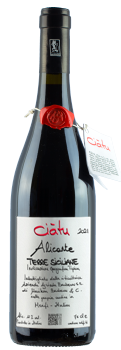
ALICANTE MENFI DOC

Alicante is a Spanish grape that was introduced in Sicily during the dominations of the XV-XVI centuries. Grown in several Mediterranean regions, it is also known as Garnacha, Grenache and Cannonau.

I love how the Alicante is influenced by the unique microclimate in Menfi, where the sea brine enhances the grapes' fruity flavors and underlines their natural acidity, enriching the wine's personality with a special saline touch.

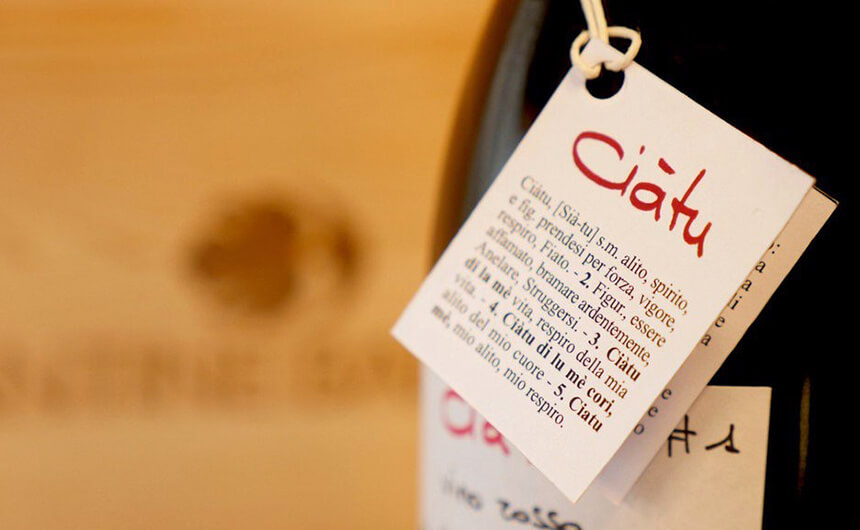
Ciàtu in Sicilian means breath: it is pure love for my land, for the energy of sunshine, for the generosity of the earth, and for the innermost breath of life.
THE SHORT STORY

THE SHORT STORY

Grape variety: Alicante from Tenuta Belicello, Vigne del Pozzo
Soil: alluvial clay soil with sandy components, medium texture, and good fertility
Vineyard: planted in 2004, vertical shoot positioning, spur pruned cordon
Winemaking: skin contact for 15 days in large neutral Slavonian oak casks
Alcoholic fermentation: spontaneous, with wild yeast
Malolactic fermentation: spontaneous
Refining: 6 months in large neutral Slavonian oak casks, and 1 year in bottles
Average production: 4.000 bottles/year

Download wine sheet

MORE ABOUT ALICANTE

MORE ABOUT ALICANTE

The Alicante vineyard was planted by my father in 2004, as part of an experimental project on Mediterranean grape varieties historically belonging to the Sicilian heritage.

This variety was brought to Sicily between the XV and the XVI century by the Aragonese, and it survives today only in some Sicilian vineyards, many of which are almost or completely abandoned.

The most famous vineyard, still located on the Etna slopes, is one of the magical places of Sicily, where centuries-old vines of ungrafted Alicante live on sandy and clay soils, close to the Alcantara Gorges.
A few years after my vineyard was planted, I started to experiment winemaking but the results were quite unsatisfactory. The Sicilian Alicante has, in fact, very thin skins that tend to flake off quite soon during the fermentation, producing a large amount of sediments that can generate severe reduction problems.
Only after several harvests and after many attempts I found the way: manual punching downs, slow but steady supply of oxygen from the earliest stages of fermentation, drastic reduction of pumping overs, and a lot of patience.

I learnt that air is the key to this wine, a wine that needs to breathe in order to express its potential to the fullest. Thus, the name: in the Sicilian language Ciatu is the act of breathing and the air that keeps us alive, but it also means love, passion, desire.

OltreVino

Ciàtu is not only one of the wines that I love the most, it is also dedicated to solidarity in association with Istituto Walden ONLUS, and supports children with autism. We aim to foster solidarity across people and social groups by creating a psychological sense of unity associated with the true and genuine taste of natural wine: a good way to understand, deal with and overcome obstacles together.

Istituto Walden ONLUS favors the creation of personalized and intensive cognitive-behavioral paths to improve the quality of life of autistic children, and assists their families since the very moment of diagnosis, helping them in accepting this complex developmental condition by providing psychological support.

Ciàtu, the wine that I dedicated to this project, is pure love. It is and intense and expressive wine that reflects the energy of sunshine and the generosity of Mother Earth, and is full of love and joy: the same love and joy that our autistic children need.

Support OltreVino!

WINEMAKING

Planted on clay alluvial soils, the Alicante vineyard is located in the eastern part of Tenuta Belicello, where the terrain is very deep and fertile. Dominant breezes blow from the sea during the day and from inside the valley overnight, a constant flow that freshens the air temperature during the summer and contributes to prevent humidity.

The harvest takes place about the end of August, when the Alicante grapes reach a perfect balance between acidity, ripe tannins and great aromatic concentration.

Taken to the winery immediately after the harvest, the grapes are destemmed and crushed, and the maceration lasts for about two weeks in a large neutral Slavonian oak cask. Manual punching downs are carried out several times a day until the end of the spontaneous alcoholic fermentation.
Malolactic is also spontaneous, in very used barriques. After it stops, the wine is delivered back to the oak cask, where it refines for at least six months without any additives or fining agents. Ciàtu is then bottled without any filtration, and will be ready to drink after a minimum of 6-12 months of aging in the bottle.

TASTING NOTES

Ciàtu is a hot-blooded, intense wine. It may appear somehow uptight and perhaps skittish at first sip, but it can be extremely generous with those who know how to respect his times and are patient enough to appreciate its slow evolution in the glass, even after several days from the bottle's opening.

It is an inky and impenetrable red wine with a seamless presentation of dark fruit aromas. In terms of flavor, it takes you slightly off guard thanks to a sour point of fresh blackberry that is characteristic of the Alicante grape, and stands out against exotic layers of fine herbs, spices and sea brine. Its captivating palate is juicy and fresh, with smooth silky tannins, a well-integrated acidity and a long finish.

It is perfect with all roasted red meats and spicy dishes, and it is very interesting with big steamed Mediterranean red fishes: a spicy soup like the Cacciucco toscano, a hot Tunisian couscous, served with fish and vegetables, and a tuna-fish steak are my favorites. It is also a delicious companion to medium-aged cheeses such as Caciocavallo ragusano.

SERVING TEMPERATURE: 57 - 61 °F
Ciàtu is not fined, nor filtered, which will benefit its structure and longevity if you follow some basic rules for a greatly satisfying tasting. Store the bottle in a horizontal position, and make it stand a few hours before you want to open it, to allow the sediments to collect at the bottom. Please pay attention while pouring the last glass, which is the one where some sediments may deposit.

This site uses cookies and third-party cookies to provide you with a better experience and service.
When navigating or using our services, you agree to our use of them. You can change your cookie settings at any time.