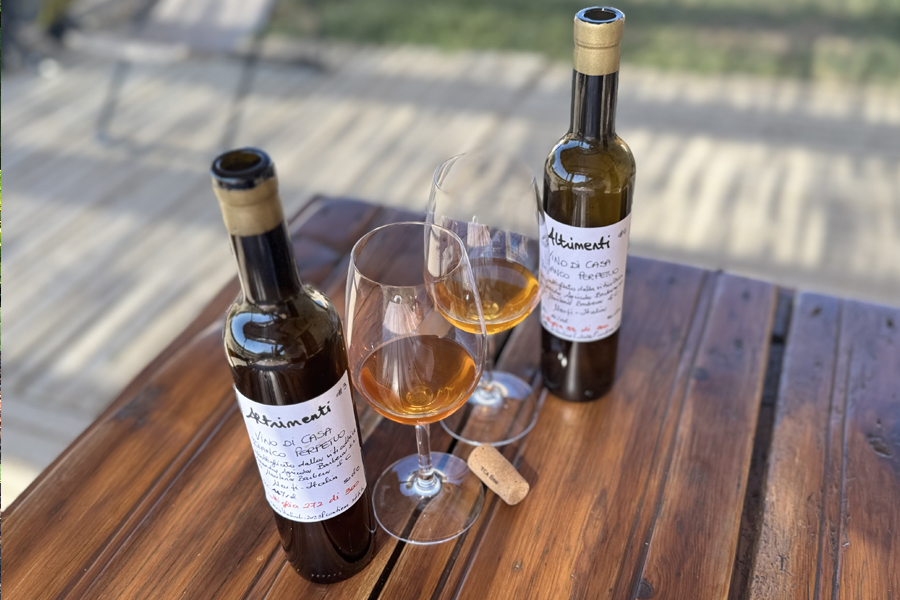

Altrimenti comes from a single barrel that I started in 2012, replenishing it every year with Inzolia from our old vineyard, planted around 1965. Each harvest brings new wine into a story that is already unfolding, while every bottling carries within it a trace of every year that came before. That's why vintages become almost irrelevant here. What truly matters is the rhythm of time itself.
In January 2023 we bottled Altrimenti #3, in January 2026 the #4.
One would expect the same wine, separated by only three years—especially after such a long refining—to have changed very little. Yet, in the glass, these two bottlings seem to look at the world from opposite directions.
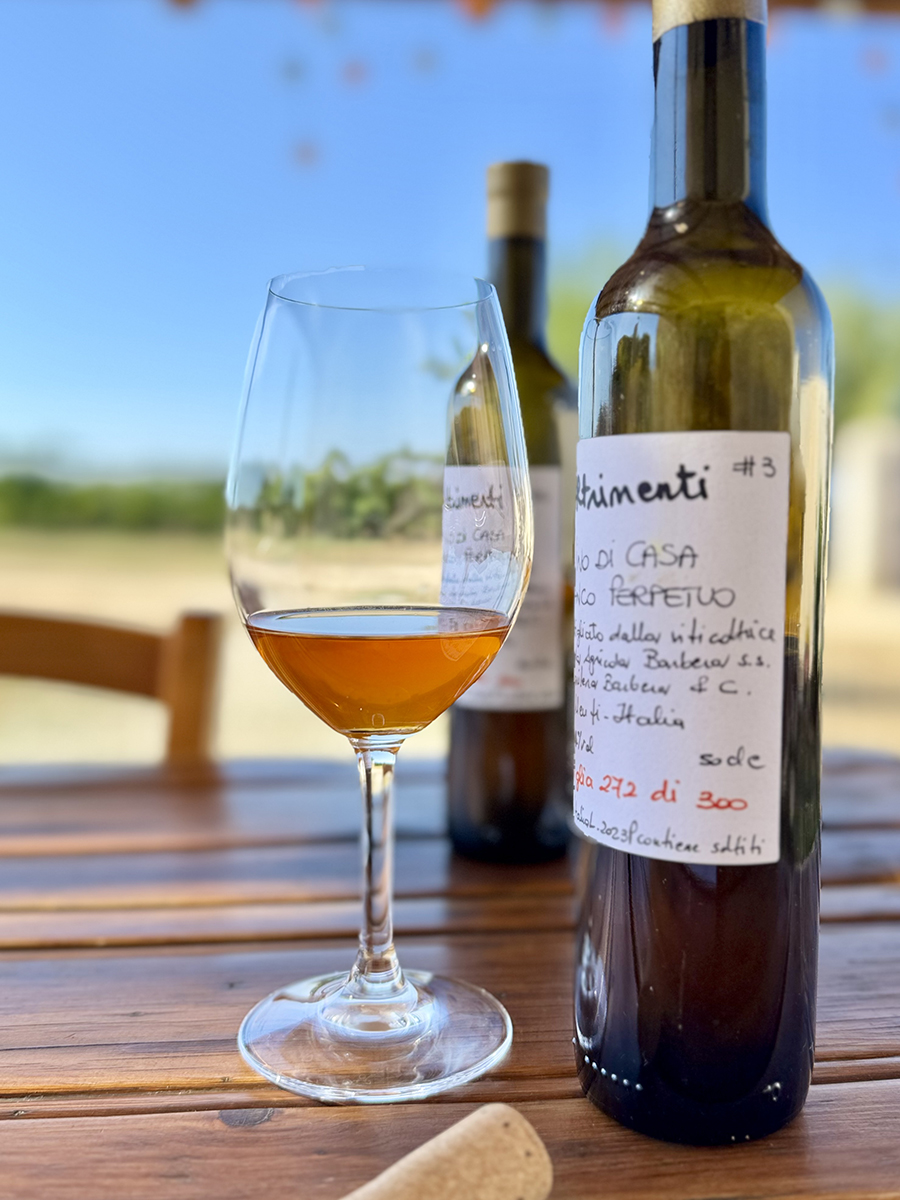
Altrimenti #3. Basquiat
Our first thought was Jean-Michel Basquiat. Not because of its intensity, but because of its materiality.
Salt is no longer just salinity. It grows thicker, changes character, and pushes toward something almost peaty, as though the salinity of Menfi, shaped by time, had become substance: dense, dark, almost smoky. Time and oxidation have done very little to smooth this wine. Instead, they have engraved it. Every element remains vividly exposed, leaving its mark on the deep, warm colour, on the texture, and on a vibrant, lingering finish.
This is not a wine that seeks refinement through simplification. It doesn't conceal itself, nor does it aspire to elegance. It layers. It holds together energy, salt, light and depth. Like Basquiat, it does not caress matter—it intensifies it. It scratches, overlays, insists. Its energy comes from matter rubbing against itself.
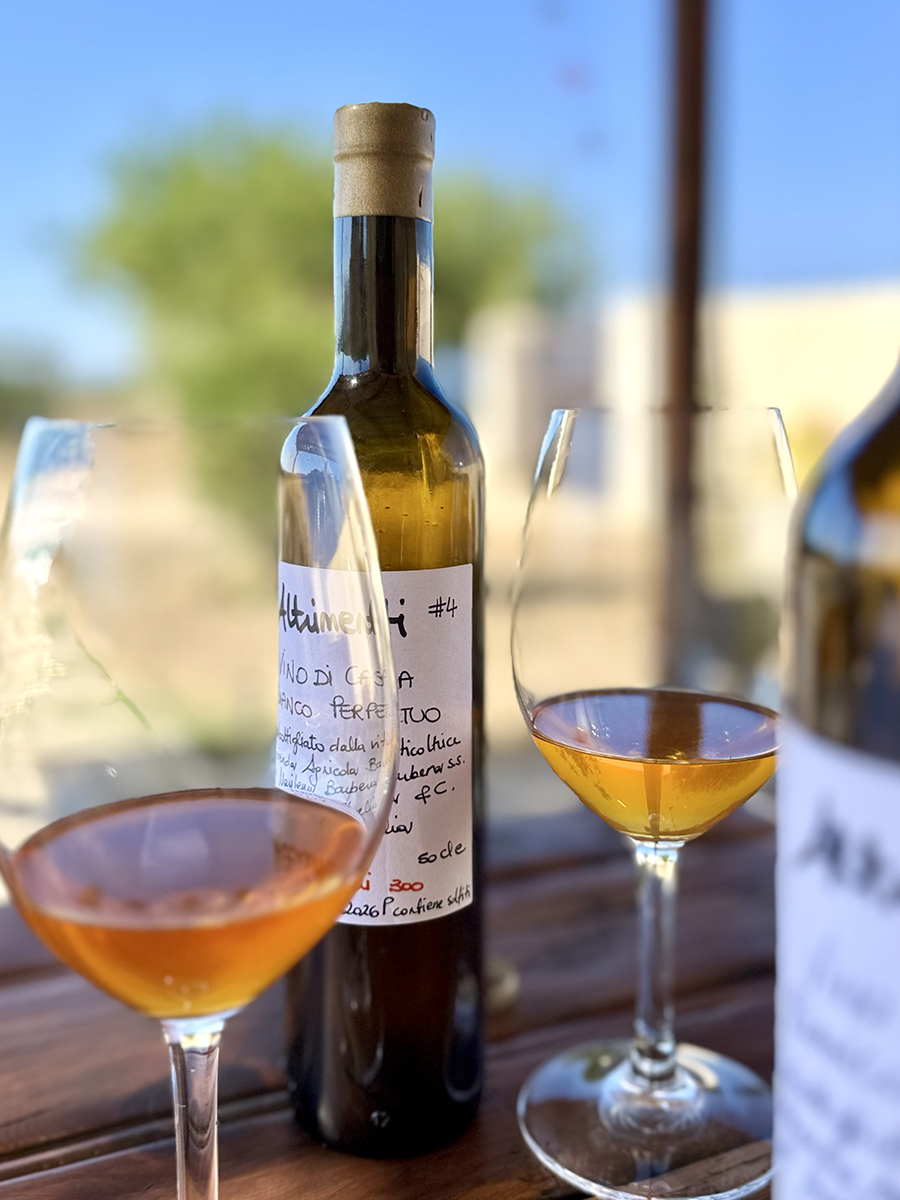
Altrimenti #4. Piero della Francesca
Three years later, from the very same barrel, something entirely different emerges.
The materiality has not disappeared; it has become almost transparent. You feel as though you could see through it, catching a glimpse of the genius loci beneath. The individual components no longer compete for attention. You no longer perceive simply the grape variety, the perpetual method or the salt. Instead, you sense a unity that transcends all of these elements and resolves into a single form.
It reminded us of Piero della Francesca. In this wine we found a promise, an aspiration toward order—not an attempt to describe its place of origin, but to reveal its most intimate and essential form.
#3 and #4 are not two stages along a linear path of evolution. There is no imperfect beginning and perfected end, but simply two different ways of inhabiting the same place.
In #3, the territory is body, matter, energy. In #4, it becomes form, light, idea.
Both wines are true. Both are necessary.
Perhaps this is what fascinates me most about a perpetuo. Time does not simply make a wine older, or even more complex. It allows the wine to discover entirely new languages.
And it seems to me that, in this tasting, one spoke the language of the matter from which this terroir is made, while the other spoke the language of its form.